Saturday, 27 May 2017

The Past is my Future


The "Howley Project" has been in my life now for 10 years and I am gratified to see it come to a close and satisfied with the resulting artwork.  

This work that I have done has now led me down the path to more research and discoveries.  From my interest in James Howley I have become interested in the Central Newfoundland Dunnage Zone and found there has been lots of research in that area and it is still ongoing.  I’ve amassed a collection of geological reports that have been helping me find my way through the “melange” and I find other large footsteps to follow such as another geological idol, Hank Williams.

Last summer I spent time in Moreton’s Harbour and Salt Harbour scouting out some formations in and around those areas.


Little Harbour, near Moreton's Harbour


Carter's Cove


Strong's Island


Pike's Arm


Reading the reports I was inspired by the descriptions of the geology of the region and intrigued by the dynamic geological history of the land formed by the death of an ocean, Iapetus.  More research to be done on that subject and another body of work in the future.


Once again, my work in the QEII Library assisted me in finding inspiration and I spent a lot of time browsing through the geology subject area in the stacks.  I found many non-technical books about men who helped shape the story of the Earth.  James Hutton, William Smith, and Arthur Holmes (just to name a few) and I found other books that explained Earth’s story and helped me to better understand it.  I’ve started my own geology library and the titles I find in the QEII are added to my Amazon wish list!


I am working on one more painting for the Howley series and I reflect on how much I’ve learned from James P. and how much more I want to learn from those who have preceeded him and those who have followed him. The journey for me is just beginning.


Friday, 17 March 2017

Sorting Out the Red Mess

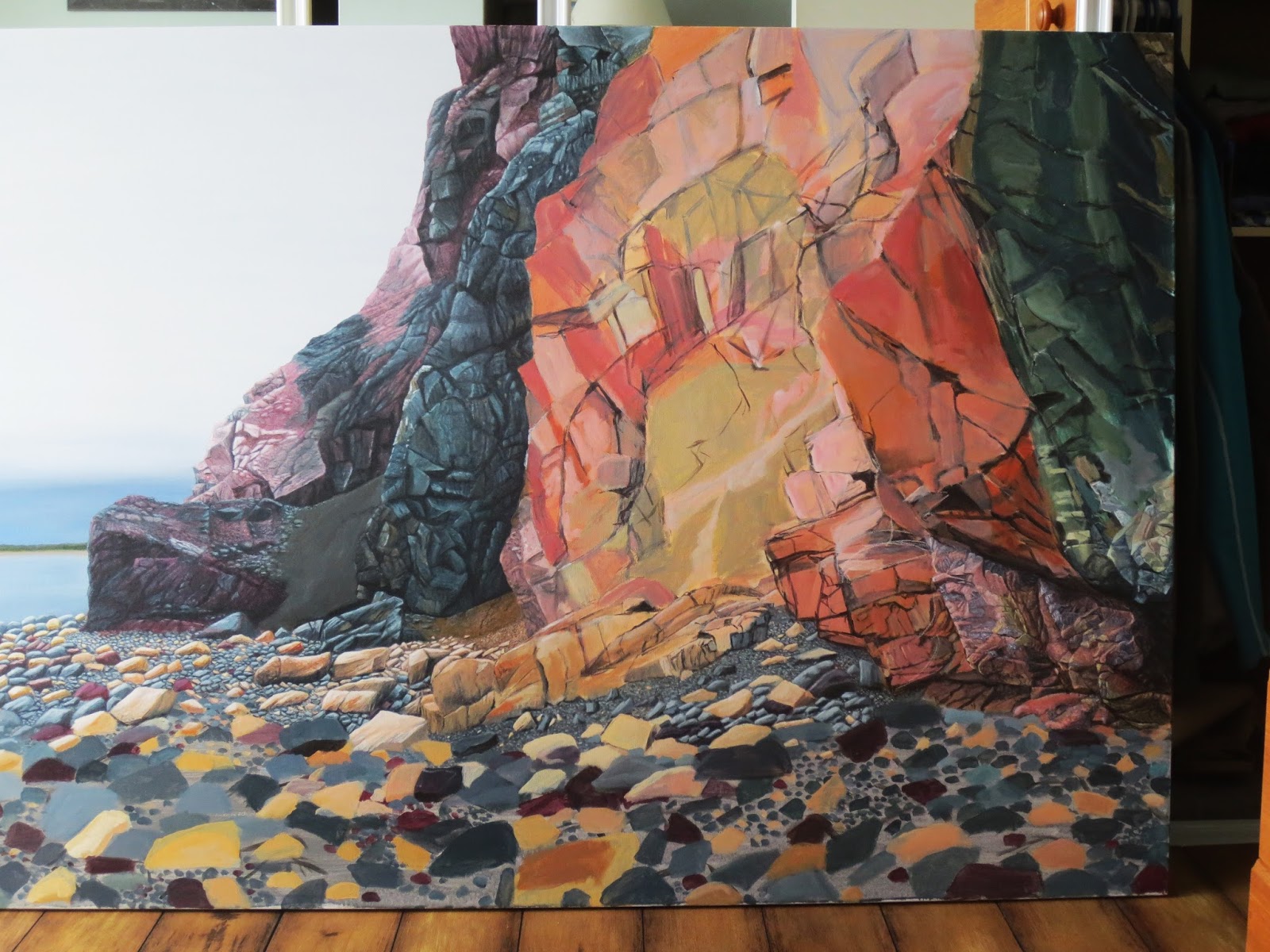
I am nearly done the painting of the confusing geology of the section near Little Dantzic Cove.  While this whole structure has many features, the part that is the most challenging is the enormous bed of red shale that takes over the foreground of the painting.  Howley writes in his field book:  “the limestones and red shales are troughtt (?) up by a fault and broken and distorted in all manner of forms”

“All manner of forms” is correct, the bed is abundant with different shapes and textures and seem to make no sense.  


It is an immense area to paint in detail and I had to keep building up the colour and texture before I was able to really put in the detail.  


I was also unsure about the composition at first, I thought the red would overwhelm everything else but I don’t feel that way now because of the shape of the bed, it comes down to a point, leading the eye to the rest of the structure.


There is more of the red shale out towards the end of the structure.  Howley describes this section of red shale as being “much compressed and altered"


I think he was dead-on in his description and for a lay person, these adjectives I could understand.

 As I study the photographs I am seeing the “bits of blue” running through this red bed, here and there, this blue rock shows up on the top of this bed underneath the limestone blocks and again towards the end of the structure.  


Howley describes a “small trap dyke cutting through these rocks at right angles to the dip and running very straight…”  The blue seems to unite the structure as bits of it appear throughout the whole piece.  Is this thin line of blue above the limestone in the middle of the image the trap rock?


I should be done this painting in a week or so…that is my deadline!  Then on to the last piece in the series, the barite vein of Cross Point Cove which should take me up until August.

Monday, 5 December 2016

Report of Progress II


Working away at the Dantzic Cove painting aptly named “Here All Was Confusion”.  This one is not too onerous even though it is so big.  I am finding that there are so many different types of rock here that I can work on different parts all the time and not lose interest.


Here is the start, I draw it onto the canvas and then paint on the outlines.


Put in the base colours first and fill in the sky and water


I keep filling in detail of the different parts...adding layer after layer of colour.


Then fill in the finest detail.


 Layering is a necessity in my work because that enables me to control the detail. It`s my favourite part of the process because I feel I am telling the story of the structure.  There`s an intimacy about it and I wish I was there, touching the various textures.  I can almost understand what happened here because I am spending so much time looking at the pictures and interpreting through the brushwork what I see. There’s a range of detail brushes that I use and I go through a lot of these with each painting, using the 00000 brush, 2nd from the bottom, for the final detail.


 It is impossible to paint this way on site, I would have to set up camp for weeks...like Howley! I believe he spent the better part of six weeks unravelling the shoreline of Meelpaeg Lake.  Maybe that`s another project for another time!  Hoping to have this one done by the end of January...asking for detail brushes for Christmas!

Thursday, 15 September 2016

Cross Point Cove revisited

Last week I started the Dantzic Cove painting, and it lives up to it's name...Here All Is Confusion!...I have a lot of work to do to sort out the geology of this one.


My last one in the series is located in Cross Point Cove, a rugged little cove just north of St. Bride's on the Cape Shore.


What first attracted me to this site that I read about in Howley's field book was how he found out about it.  He was in St. Brides (then known as Distress) on July 19, 1868, his first expedition with his boss, Alexander Murray, then Director of the Survey.  In his field book he writes:  "I went out after dinner with one of Mrs. Conway's sons to Cross Point Cove, north side, to see a vein of rock which from his description I took to be quartz but turned out to be sulphate of barytes".  I could picture them all sitting around the table after a big feed of dinner and the boys talking about the unusual rock nearby. 

It is quite distinct on that shoreline of red and grey-green shales (the Branch shales as he called them).


I scoped it out on the topo maps and air photos and it was quite easy to get to.  I first went there on July 19, 2009.  I took many pictures and completed the first painting of the series in 2012.  The painting is based on the image above but after doing 8 other pieces, this one didn't fit in, too much distance and not enough geology, so I decided to do another; thus the reason for the revisit! 

I set out on Tuesday, September 13 on a very warm, windy day with only the dog for company. 


Incidentally Howley enjoyed travelling solo as well.  He writes in his "Reminiscence of Forty-two Years of Exploration In and Around Newfoundland" on page 122, that while surveying the Trinity Bay area in 1869 he started off on foot from New Harbour to Come By Chance:

"One might suppose that undertaking this journey through a hitherto unknown region and all alone was a foolhardy action but this did not give me the least concern.  I rather rejoiced at the prospect of finding my way unassisted and without anyone to guide me...I continued to jog along, observant of everything around me and communing with nature as it were and quite contented and happy.  I did not mind in the least the journey or the loneliness, indeed I rather preferred the latter.  It seemed to suit my natural temperament, I was never given much to talking, but could think a lot and here I had ample scope to indulge in the latter propensity"

On my first visit to Cross Point Cove in July the weather was completely different, it was foggy and drizzly, the colours were more subdued.  But  I discovered it wasn't only the weather that was different: the next image was taken in 2009, the image below that a few days ago. 


July 19, 2009


September 13, 2016


Notice the absence of the cave directly adjacent to the vein!  My mother and I ate lunch in that cave back in 2009, sometime in the last 7 years it had caved in!  There is about 8 feet of rubble covering the vein since the last time I was there.  I can imagine the sound that made in the collapse.

Here's another before and after looking east towards the cove.


I've lost more than 1/3 of the vein and now missing some lovely "ladder veins".


2009


2016


Maybe I'll paint the older image from 2009, I love those ladder veins!  The collapse however had exposed some lovely formations of the barite on the rocks and I found this very large piece with fresh crystals (if "fresh"is the right term!)


And this pattern of crystals on the face of a huge chunk of rock that must have been part of the collapse.


 Apologies for not putting a set of keys or some reference point  next to the rock for size...not quite thinking like a geologist yet!  Anyway, it was a beautiful, inspiring day on the Cape Shore, now I am set for finishing off this series.


Friday, 22 July 2016

The Next Big One, 28 x 72


I will soon be finished the Tickle Cove Broad painting.  I am taking a week or two off from the Howley series and working on some smaller pieces for another exhibition I will be having at the Ocean View Gallery in Carbonear next August.  The pieces for this show will be small works, working title is "Shoreline Stories".  Carbonear is my home town so I'm excited to be showing my work out there.

The next piece in the Howley project [All Roads Lead to Here] is from the survey of Little Dantzic Cove on the Burin Peninsula in 1870.  I made two visits out to this cove and I am anxious to start painting it.

When Howley was there on August 10, 1870 he walked down the coast from Great Dantzic Cove.  He wrote about the quartzite and slate along the shore until he got to the point before Little Dantzic.  It is at this place that he writes "Here, all is confusion" and goes on to describe contortions, compressions, twists, and displacements.

He illustrates this in his journal.


His field books are amazing!  He managed to label rock types in so tiny a space.  This journal is not very big, 4 x 6 inches and still legible after almost 140 years!


This excerpt will be accompanying the painting, it's what I plan to do for all the paintings.  The words in the field books were what inspired me to find the places he described.  This one was especially sweet because of the illustration!

Below is a preliminary sketch of the spot.


There are so many colours and textures in this structure, I'm sure it will have its challenges, as can be seen in the images below.


It will be the longest painting I've done yet...I am excited about starting it!


Thursday, 23 June 2016

A Brief Update

Here is another image from the Tickle Cove Broad painting.  I would say I still have a few more weeks of work on it, I have been concentrating on the foreground beach rocks.  The light in the sky on the left is just a reflection, though it does give a nice effect!


Wednesday, 16 March 2016

Update on Tickle Cove Broad

I'm working away steadily at this painting, there's so many different tones in the yellow rocks, (or felsic dyke so I'm told) it really is a jumble, just as Howley described it!


As can be seen from the top and bottom image, the yellow rock is becoming more pinkish.  The colour of the samples (shown below) from this dyke are olive and a rusty reddish colour though the image of the dyke shows it as a dirty yellow colour but when I'm looking closely the rusty colour is there.  I have to make it look middle-ground as well so it is not overwhelming the foreground.


The dyke in the painting is way too pink, maybe felsic rock tends to be pinkish and the light and the camera are playing tricks on me.  Although Howley did say the rocks were yellow...I think I'll walk away from the felsic dyke for a while and concentrate on the beach and foreground rock!