

the Big Tree Studio
Thursday, 23 June 2016
A Brief Update
Here is another image from the Tickle Cove Broad painting. I would say I still have a few more weeks of work on it, I have been concentrating on the foreground beach rocks. The light in the sky on the left is just a reflection, though it does give a nice effect!


Wednesday, 16 March 2016
Update on Tickle Cove Broad
I'm working away steadily at this painting, there's so many different tones in the yellow rocks, (or felsic dyke so I'm told) it really is a jumble, just as Howley described it!


The dyke in the painting is way too pink, maybe felsic rock tends to be pinkish and the light and the camera are playing tricks on me. Although Howley did say the rocks were yellow...I think I'll walk away from the felsic dyke for a while and concentrate on the beach and foreground rock!

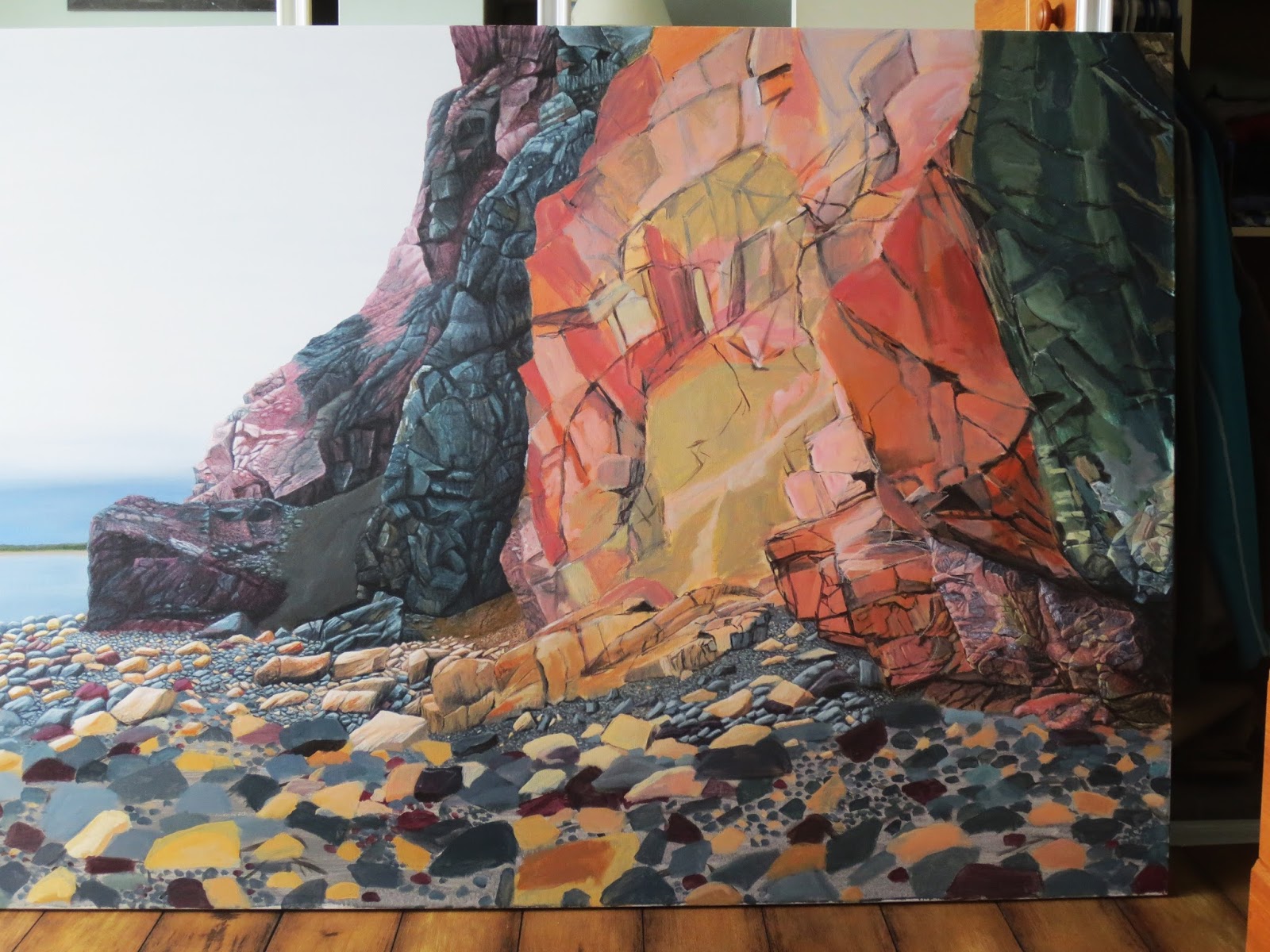


As can be seen from the top and bottom image, the yellow rock is becoming more pinkish. The colour of the samples (shown below) from this dyke are olive and a rusty reddish colour though the image of the dyke shows it as a dirty yellow colour but when I'm looking closely the rusty colour is there. I have to make it look middle-ground as well so it is not overwhelming the foreground.


Sunday, 17 January 2016
The Devil is in the Details
You would think that by now I would be embracing the details that go into the work that I am doing but it still takes me a while to get the focus and start working my way into it. Here are a couple more images, quite a bit more done since I last posted.


I am delighted with all the different colours I am finding in the above section of rock from the close up images taken with my camera.

When I am at the site taking pictures and sketching, I am not seeing this so clearly. Maybe I`m just too focused on the composition or making sure I am in the right spot that I miss the details...still not thinking or observing like a geologist! Now I want to go back to Bellevue Beach to touch all those textures and experience those colours.

When I am at the site taking pictures and sketching, I am not seeing this so clearly. Maybe I`m just too focused on the composition or making sure I am in the right spot that I miss the details...still not thinking or observing like a geologist! Now I want to go back to Bellevue Beach to touch all those textures and experience those colours.
Below are a few excerpts from Reminiscences of James P. Howley, Selected Years. When I first read this book I was totally captivated by his words. His descriptions of exploration in Newfoundland left me with a longing to wander and be immersed in the rocky shores and interior of the island.
I hope you find wanderlust in the following passages!
Page 4, Howley`s introduction:
The silence, the sense of being free from care, unworried about the doings of the outside world, the solemn communing with nature possessed an indescribable charm all its own. The whole civilized world might be labouring in the throes of turmoil, wars, pestilence, devastation, etc. etc. What cared we, we knew nothing of it all and felt happy in our ignorance of the doings of the world at large. In fact, we became lost to all sense of anything but our immediate surroundings.
Page 123, 1875. Red Indian Lake:
Finally, we reached the long-looked-for Red Indian Lake. Here we were at length on this great inland sea, stretching away to the westward thirty-six miles. It presented a glorious sight in the calm mornings, when the surface unruffled by a single breath of wind looked like a gigantic mirror spread out before us. The dense dark forest clothing its shores on every side lent a particular charm to the magnificent scene. It was truly sylvan beauty of the most glorious kind. I shall never forget the impression produced upon me at this first sight of the erstwhile home of the extinct Beothuck.
Page 276, 1888, Noel Paul`s Steady:
We were more charmed than ever with the scenery on Noel Paul`s Steady especially in the gorgeous sunset. It was a delightful evening and the autumnal foliage of the forest was beyond the powers of the pen to describe. It would make a magnificent picture, could it be transferred to canvas in all its variegated hues. The whole was reflected with its profuse colouring in the mirror-like surface of the water. Here and there along the margin of the river a yellow marsh added a golden fringe to the picture, such as would cause an artist to go into ecstasies.
Sunday, 15 November 2015
Howley and the Beothuk and Tickle Cove Broad, The Process
On November 5th I attended a symposium by the Newfoundland and Labrador Archaeology Society in commemoration of the 100th anniversary of James P. Howley's book "The Beothuk or Red Indians". Below is a link to the keynote address by Gerry Penney from the Archaeology Society's webpage. Thank you Gerry for sharing!
James P. Howley, “the birth of Newfoundland archaeology, and the end of history” (PDF).
Howley extensively researched the Beothuk and mentions them often in his Reminiscences, His book recounts the history of the Beothuk encounters with the European explorers and settlers and their eventual extinction. It is the first comprehensive book about the Beothuk and has been for many decades. The book is also available on-line from the Queen Elizabeth II Library's Digital Archive Initiative website:
http://collections.mun.ca/cdm/compoundobject/collection/cns/id/26831/rec/577
Art
I thought I would show the painting process of Tickle Cove Broad. I started work on it October 22nd. I usually sketch out the image on large paper in reverse then transfer it onto the canvas with tracing paper but I didn't follow that procedure with this one. The basic outline is less complicated I think than the previous I've worked on...or maybe I just got lazy!
So, I started outlining the shapes, then filled them in with the basic colour, did background and sky, I usually get that out of the way first so I can concentrate on the geology. As I'm blocking in the colour my eye keeps scanning the photos for the detail. On first glance the cliffs look like they are three different colours but as I get closer and closer I see the variations in each rock type.


In his field book Howley stated that on the west side of Tickle Cove Broad there were cliffs of red, yellow and green rock all jumbled together. The more I progress, the more I see bits of green mixed in amongst the red, and yellow into the green.


I sometimes forget the detail that goes into the pieces and figure I can whip up one section with a few brush strokes...but the rock drags me in and I start working with my tiniest detail brush, layer after layer in small areas. It's like geological time, structures are formed and built up and taken away over millions of years. I feel I am building and building colour and texture slowly, like geological time and even though this step is the most onerous, it is the one I like best. There's an intimacy about it, I feel very connected to the structure as I unravel its mysteries.

Friday, 9 October 2015
Three Rock Cove, Tickle Harbour Broad and some important dates.
I have finally completed the Three Rock
Cove painting, here are a couple of images, half-done and finished:


This one was more challenging than the Brigus cross-section, so much texture in the rock here. The next painting coming down the pipe is the red,
yellow and green rocks all jumbled together at Tickle Harbour Broad, a.k.a.
Bellevue Beach.


I don’t understand why the name was changed,
Tickle Harbour Broad seems like a true Newfoundland name, though these days it
would probably be called THB! I have
been to this beach many times before I found reference to it in Howley’s 1869 field book so I was very familiar with the geology there. I had done a painting of some of the yellow sandstone while in art school back in the late 80’s and always felt it was a special
place.

The rocks here are so
interesting and it is an easy place to spend a day wandering and sketching.


August 24, 1869
Altogether the cliffs are
very peculiar composed of red, yellow and green rock all jumbled together and having
a smooth slippery appearance. There are
some small quartz veins cutting through here and there, some of which are …on
both sides by a curious green fibrous mineral in some places nearly two inches
thick.
Some important dates:
I have changed the date of the exhibition
to September 2017. I have four more pieces to complete and at
the rate I’m going the timing would be perfect.
Also, below is a link to information about a
symposium by the NL Archaeological Society in honour of the 100th
anniversary of James P. Howley’s book “The Beothuk or Red Indians”. In researching his
field books I found he often mentions the Beothuk and looked for traces of them while
surveying in the interior. The symposium
will be held in the Landing at the University Center, November 5, 7:00 –
8:30. It should be an interesting event!
Saturday, 8 August 2015
It's all about the rocks
Last year on my trip to Dantzic Cove I felt I hadn't really spent enough time at the site and went away too soon, not investigating properly what Howley described as a "great deal of disturbance". This summer I planned a family vacation to the Burin Peninsula in order to get back there. My husband, son, his friend and I spent four days in Garnish which included kayaking, golfing, swimming and a hike back to Dantzic Cove.

This time I got up close and personal with the rocks. It's so much better to be able to touch and observe the rocks then look at them from a camera lens, because of an impending thunderstorm that's all I did when I first visited there in 2014. This time I walked all over them, all the way out to the end as far as I could safely go. In Howley's field book of 1870 he states "here all was confusion" and I certainly saw that. There was no clear pattern in the structure, nothing but a jumble of textures, shapes and colours in this little gulch.


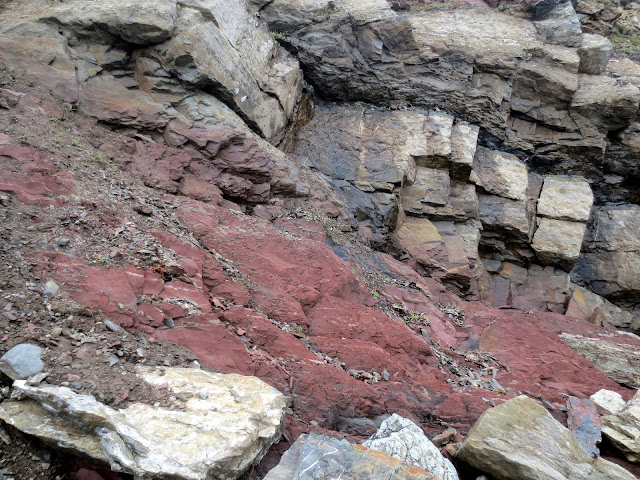


As an "arm chair" geologist I don't know how to describe what kind of energy was required to create such a convoluted structure. I recognize folding and a geological map of the area shows that a fault runs through here. But despite all that cataclysmic action in the past, I got a peaceful, quiet feeling from the place, as if the earth's processes had finished all it had to do here and left the rocks in a tight squeeze with each other..like a geological group hug!


This time I got up close and personal with the rocks. It's so much better to be able to touch and observe the rocks then look at them from a camera lens, because of an impending thunderstorm that's all I did when I first visited there in 2014. This time I walked all over them, all the way out to the end as far as I could safely go. In Howley's field book of 1870 he states "here all was confusion" and I certainly saw that. There was no clear pattern in the structure, nothing but a jumble of textures, shapes and colours in this little gulch.


Saturday, 6 June 2015
Catching Up - Accolades for James P. Howley
I haven't posted anything in a while, it has been a long Spring and I've had two bad colds and a stomach bug, but I'm back on my feet again and still working on the Three Rock Cove piece. I am very pleased with how it is coming about. I love fleshing out the shapes and textures I find in these structures. Things I didn't even notice until I have brush in hand, standing in front of the canvas and intensely studying the photographs from the site; curved lines, jagged lines, broken lines, smooth here, rough there, split apart, caved in...what stories these rocks tell!

In an earlier post (October 2013) I mentioned that James P. Howley's name was put forward to the Historic Sites and Monuments Board of Canada to be considered as a person of historical significance. I found out recently that the Board had accepted the nomination and Howley is now a person of historical significance in Canada! This means he will be marked by a plaque at The Rooms.
Here's an excerpt from the Minutes of July 2012 Board meeting:
Four significant points for which he was recommended for designation:
1. His study of the Beothuk Indians published in 1915 remains the cornerstone of all subsequent research on the subject;
2. He is regarded as the creator of the institution that became the provincial museum in Newfoundland and Labrador and served as its first curator, overseeing the consolidation and expansion of core collections;
3. He trained under Alexander Murray, his work as an assistant and then as Director of the Geological and Topographical Survey of Newfoundland between 1868 and 1909 produced much of the scientific basis for understanding the geography of the interior Newfoundland, its geology and mineral deposits;
4. His memoirs are a valuable record of Newfoundland's earliest scientific explorations from a personal perspective and constitute a unique historical record of late 19th and early 20th century Newfoundland life beyond St. John's.
In my early days of research I was fascinated with the writings from his field books. The geology was interesting in itself for me but his tales of travelling around the province on foot and visiting the outports were truly a glimpse of Newfoundland at that time. I enjoyed seeing the landscape through his eyes, the grand vista of the Humber Valley from Mount Seemore and the pleasures of canoeing a "verdant" tree-lined steady. From sleeping in "comfortable quarters" to shivering in a "miserable tilt", his enthusiasm for fieldwork was infectious and I found myself wondering why he wasn't really well known to the general public.
Many thanks to Gerald Penney and Derek Wilton for submitting this nomination.
Subscribe to:
Posts (Atom)